

The Process

Alchemy Acoustic Labs’ AO1™ Process was developed from years of research by polymer chemist Frank Sanns.
Frank has long been fascinated with finding the “ultimate” acoustic guitar. His quest started with a scientific exploration of the Stradivarius phenomenon and has led him through some of the finest acoustic instruments in the world. As he experimented with these instruments, he observed some intriguing physical differences and similarities within their sound-producing properties.
Most guitarists agree that older guitars sound better than newer ones. But Frank drilled down to the next level. WHY do they sound better? One reason is that your guitar was a tree for a lot longer than it has been a guitar. The cellular polymer properties of the wood are still acting like a tree which, while optimum for resisting gale force winds, is not conducive to producing the best musical sound.
So the question is, how can I take my not-so-old guitar/mandolin/violin etc. and make it forget that it’s a tree, sooner rather than later? How can I take my beloved newer instrument and make it sound to me now like it will, or better than it will to my grandchildren’s grandchildren someday?
That’s what the patented AO1 process does.

What is it?
The AO1 Process™ is a patented, multi-stage process that reconfigures the properties of the wood of a guitar, relative to its performance as a musical instrument. It is a precision-tested and calibrated system that targets and affects each guitar differently, based on the intrinsic qualities of the wood of that instrument.
The instrument is placed in an anechoic chamber and scanned by a proprietary sensor system that maps the input and output response of the primary sound forming surfaces of the instrument. Those responses are then used to establish unique process parameters that will be implemented on each individual instrument. Just as no two instruments are the same, the AO1 process is custom calibrated for every instrument.
Once the process parameters are mapped, various locations of the instrument are targeted and non-thermally annealed by focusing high energy sonic waves of extremely specific energy levels at corresponding specific locations on the instrument while response measurements are tracked simultaneously.
The AO1 process allows for symmetrical, properly located oscillations to occur in the sound-forming surfaces of the instrument and manifests itself in greater volume/dynamic range, richer, more full sound, and greater responsiveness to the player’s touch. Over the course of the following 4-6 weeks, the instrument will continue to transform to its full 100% potential assisted by frequent playing.
To simplify a complex and precision-oriented system – The AO1 Process™ “ages” the wood in a specific pattern, optimized to the unique sound-producing properties of a given instrument.
By changing the nature of the wood we are able to increase the resonant amplitude of the instrument, giving it more sustain, making it louder, more dynamically balanced, easier to play and more articulate. (Many of the immediate questions that arise from these claims are answered in our FAQ Page)
It is also helpful to examine what the process does NOT do. It does not alter the color or tone of an instrument. If a guitar is deep and woody, it will remain deep and woody. If it is bright and crisp – it will remain bright and crisp. The underlying, founding point of the process is that it is YOUR guitar to its fullest potential.
What the patented AO1 Process™ does NOT involve:
- Shaving or cutting of any kind
- Humidity changes of any kind
- Removal of ANY wood or material
- Chemical treatments of any kind
This is still the guitar that you selected above all others, that you play and love. Just…better.
It’s everything your guitar will be someday – just sooner.

Our goals for this process are nothing short of striving to improve the performance and sound of every quality guitar on the planet.

To date, we have recorded proven, quantifiably-graphed improvement on 100% of the guitars we’ve processed. Every single instrument to which we’ve applied the process has improved within the following parameters:
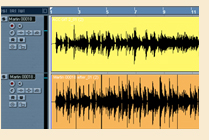 |
Increased Resonant Amplitude – The overall volume on the guitars comes up. This is recorded and observed by waveform analysis using a digital oscilloscope before the process is applied to form a baseline and then measured exactly the same way after the process has been completed. |
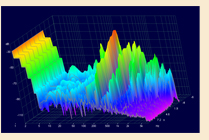 |
Increased Dynamic Range – In addition to overall volume, the process also brings up dead spots in the dynamic range of the note spectrum. This is as close as the process gets to affecting something like “tone.” Though not precisely what one would associate with what musicians call “tone” it is capable of uncovering a “sparkle” or bell-like quality in the highest end or a series of subtle overtones or harmonics that were less present before the process. Imagine striking a bell with a cloth dampening it. Now imagine removing the cloth and striking it again. Same bell, more sound. |
 |
Increased Articulation – In some guitars, the process brings out an effect not unlike that of an acoustic compressor, or more accurately – the classic compressor/expander combination. Whereas notes on an unprocessed instrument can be tracked with a typical Attack, Decay, Sustain, Release (ADSR) curve, a processed guitar will show a much more complex behavior pattern which will often rise again within the normal cycle. This creates an effect that seems to redouble and gain from its own amplitude, like a wave. This produces an increased sustain aspect, especially noticeable in registers of the instrument that previously decayed more quickly due to inherent physical limitations. |
 |
Decreased Player Fatigue – This is one of the effects of the process that is easy to understand but harder to quantify. We create volume with our hands, fingers and arms. After the process, we are using less energy to produce the same volume when fretting, strumming, gripping etc. Therefore, we find ourselves able to play for an extended period of time with less fatigue. |
You have a fantastic guitar that you love. Think it can’t get better? Would it be better in 50, 75, 100 years? Are you ready to experience just how great it can actually sound NOW?